

Updated: Aug 25, 2023
Location: Lima, Peru
Date: Summer 2018
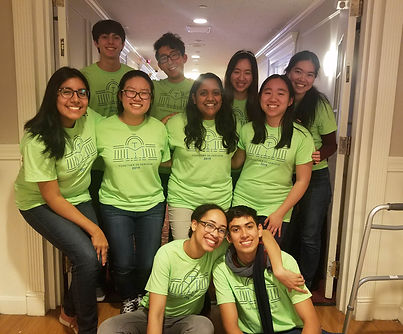
In partnership with MIT MISTI-Peru & La Victoria Lab, I traveled to Lima, Peru for three months to work in Innova Schools, an educational company. My work was to serve as a customer service chat representative for our online platform and design a chat-bot to replace manual communication, accessible to parents with little technology experience.
user-centered design | digital interfaces | customer service | Spanish | innovation environment & teamwork
Timeline: 3 months
What I Learned:
The workings of a design & innovation sector inside a corporation
Professional communication in Spanish
How to seek mentorship & advocate for oneself in a project
Designing UX experience with accessibility as a priority

The reason why I decided to go to Peru through the MISTI Peru program at MIT was very personal - I wanted to go to the country where I was born for a summer and experience a glimpse of the life I might have had if my family had decided to stay. Connecting with roots and family. Connecting with language and food.
All of this mindset extended to my design adventures in Peru.
La Victoria Lab in Lima, Peru is an innovation lab that works on projects for Intercorp, one of the biggest corporations responsible for companies such as Interbank, Inkafarma, and Innova Schools.
http://lavictoria.pe/ The lab primarily designs digital tools to aid the corporation's ventures, but also has become involved in educational ventures, service design, and organizing conferences to celebrate & bolster the spirit of innovation in the country.
When I was able to connect with Oscar Malaspina, one of the founders of the lab, I was inspired by his vision to visit Peru not to look at the streets from my own mixed Peruvian-American identity, but also through an interdisciplinary lens of social awareness, technology, and art that I soon learned had a name: design.
My first day at the lab I was introduced to various designers in the space. I walked, legs shaking, into a vibrant, colorful space full of murals and big, open rooms - a quaint little house at the edge of a one-way street. Posts-its everywhere - sharpies of all different colors. A big painting on the wall to the second floor that said - "Make mistakes first, ask permission second." Even the restroom had positive mantras & funny comics taped to its walls. The kitchen had tea. I had never seen that before! A kitchen in a workplace? Events where designers just came in and talked about innovation? Wow.


My coworker took me on an expedition around the city and into grocery stores with the purpose of showing me differences in aesthetics & price levels depending on what part of the city we were in. Later, my team described this work as Design Research, although at the time I was looking at it more from an anthropological level. I later realized design research can be anthropology, when looked at it from a social justice & behavioral lens.
My time at La Victoria Lab ended as I was assigned a project in Innova Schools - a innovative education company located on the 9th floor of the Interbank Tower. The drives to work during the mornings remain some of my most vivid memories of my time in Peru.
My first job was to manage customer incidences in real time as a online messaging platform was being developed for parents, students, and teachers. For the first month, I managed100-200 questions a day, often juggling many questions at one time. I collaborated with both the programmers and project managers in understanding the issues at hand and communicating those in a timely manner such that the bugs could be fixed in our platform.
Once I became familiar with the questions parents asked, my other main project was to design a chat-bot to reduce this manual messaging labor. This bot to not only needed to appear as welcoming as possible to parents with little technology experience, but it also had to be clear, concise, and friendly. So, to achieve this - I broke down my list of common questions and presented them in a step-by-step approach for the parents.
And so, Betty was born.

Betty. Graphic designed by Luciana Bueno.
In the design process, I asked for feedback from my supervisors and innovation team, all while tweaking the questions and answers in real time based on how parents were stumbling during their interaction with the bot.
In Summary:
As my first internship experience, working with Innova Schools taught me the fundamentals of expectations at the workplace, pacing myself, and communicating with coworkers. Observing my inspiring colleagues, I learned the value of pushing for innovation in the workplace for larger social impact. I immersed myself in various disciplines (coding, web-design, customer-service) and delighted in how my colleagues collaborated across boundaries.
In Peru, I grew as a designer, strengthen my Peruvian identity, and stretched my own ambitions.
Read more about the personal journey here: https://mistiblogs.com/tag/mit-peru/
Thank you to my colleagues Jona, Paola, Anite, Sergio, Luciana, Angie, and Abraham for helping me feel included, challenging me, and bringing so much joy to my experience in Peru.
Updated: Apr 24, 2023
Location: Cambridge, MA
Date: Spring 2018
Watch the presentation here! https://vimeo.com/271886578
As part of 2.00b Toy Product Design class, I collaborated with 4 other teammates to design a momentum-powered water gun called Water Master. We engaged fully in human-centered product design - starting in ideation and jumping to validation and prototyping, culminating in a final theatrical presentation. My work was to help mediate conflict, write and direct the final presentation, and push for accessibility in our design.
ideation | project management | script writing | inclusive design
Timeline: 3.5 months
What I Learned:
"Play-tested" our prototypes at the Boston Children's Museum, validating ideas and receiving feedback from children themselves.
Basic CAD skills
Shop: laser printing, adhesives (epoxy), sewing, wood
Constant inspiration from staff & mentors about embodying a path in creative making.

As part of the 2.00b Toy Product Design Class, as a group of 4 first-year students and I were given the task to design a toy that fit within the concept of “Dream” with a budget of $700, access to maker space, and a semester’s worth of time.
The inspiration for this mechanism was due to everyone on my team's love for Avatar: The Last Airbender. We wanted to create a toy that simulated the experience of "water-bending", or controlling water just by the force of the arm's movement.

The momentum feature of our toy was implemented by using a two-part system—a pump in the backpack that must be pre-pumped by the user before putting on, and a valve attached to the wrist mechanism that opened once the accelerometer detected speed over a certain threshold.
A couple of more features of our toy we were proud of:
The backpack, filled at maximum capacity, weighed no more than 5 lbs.
A button-safe on both the left and right sides of the handle that when pressed would not allow water to shoot out of the water master. This was to account for both left and right handed children.
(A quick story about this - Prof. David Wallace stood before us during a design review and stated he felt very strongly that this accessibility requirement were to be included in our final design. I had never visualized equity as a feature in a product before, and pushed for our team to keep this feature through the end even when the design became mechanically more challenging. During the final presentation when I was hiding on stage, wearing my rainbow suspenders and pigtails, next to Prof. Wallace and this feature of our product was presented by my teammate followed by exclamatory cheering from our crowd, he turned to me and said, "I told you they would like it" with a huge grin on his face.)
In Summary:
As my first team-experience with product design at MIT, my team and I successfully created a momentum-powered water gun inspired by "water-bending", and after iterating through various form factors, water-protection methods, and valves, produced a working prototype and a hilarious final presentation.
I actively contributed to the open communication within our team, pushed for accessibility, and also wrote, directed, and acted in the final presentation. Water Master taught me the fundamentals of human-centered design and allowed me the opportunity to mix creative play with physical design & critical thought.
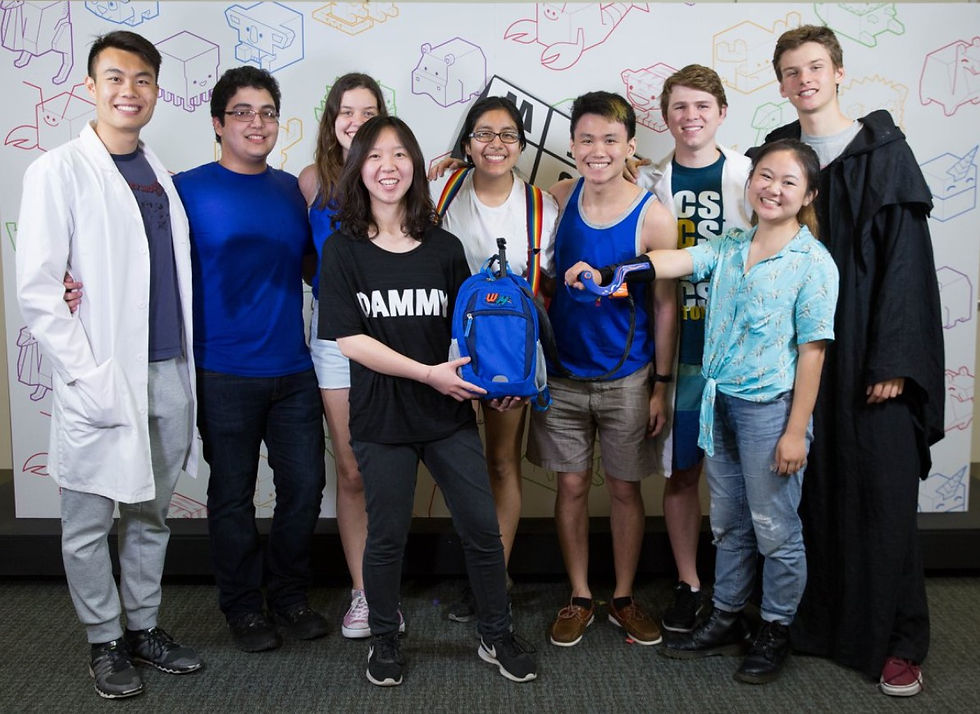
Thanks to Prof. Wallace, Dabin (mentor), Justin & Jason (TAs), and my teammates for a wonderful experience.
Updated: Apr 24, 2023
Location: Cambridge, MA
Date: Spring 2019
Read more about the experience here:
To explore the intersection between international development and mechanical design, I enrolled in D-Lab Design. Working 4 other incredibly inspiring women, I prototyped a 3D-printed telescopic orthotic for kids with cerebral palsy. My work was to push the team forward, communicate with our host company Prothesia, and collaborate in the human-centered design ideation/validation/prototyping phases.
ideation | prototyping | low-cost technology | 3D-printing | Spanish
Timeline: 3.5 months
What I Learned:
Converging on a clear scope & timeline at the beginning of a project.
Candid conversation regarding bandwidth of team members around delegated tasks.
The importance of asking questions & advice from mentors around component trade-off, mechanical analysis, and team dynamics.
Shop skills: 3D-printing, wood & foam prototypes, bandsaw, CAD

Our challenge was to adapt the growing foot of the child by creating an adaptable sizable orthotic. This would significantly reduce the amount of money each family would have to invest in orthotics for their children, because they would only have to buy an orthotic every 3-4 years instead of every year.
Because as mentioned before, our main challenge as a team was addressing how to make an object that was custom-fit for a child adaptable to their growth, we thought about many different angles.
Can we change the material to be elastic in some way?
Extenders attached to back or front of the orthotic?
Extenders inside the orthotic?
Would different shapes faciliate & optimize the extension?
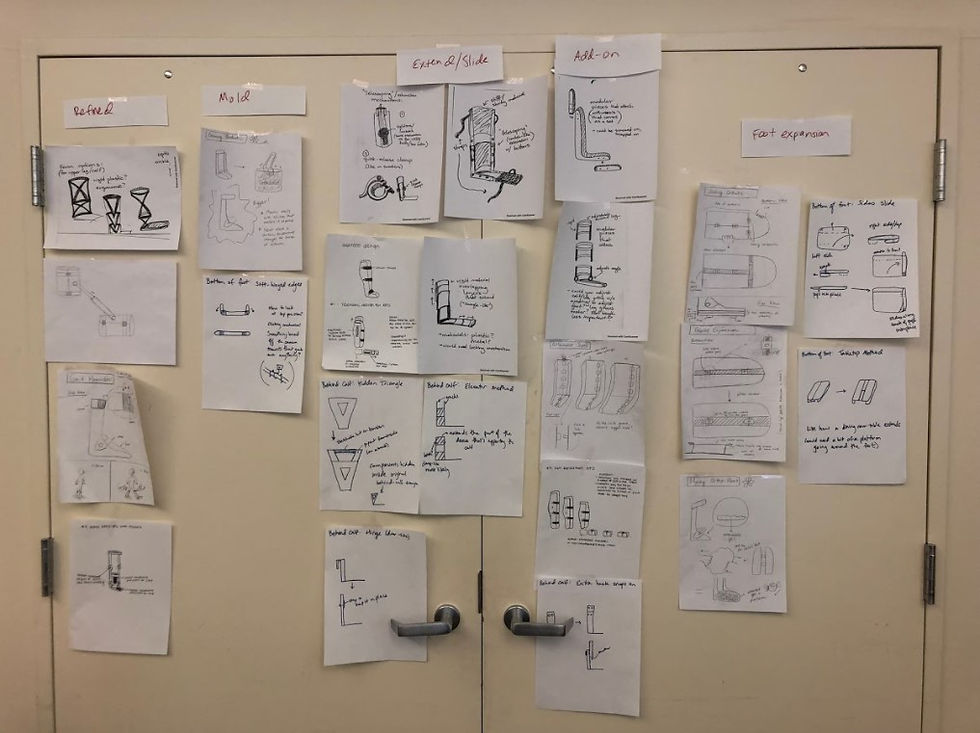
In the end, my team and I decided that in the scope of the class, we would figure out an internal extending system that would adapt to the average growth measures of children ages 6-8 years old, and also prioritize comfort & accessibility of the expansion.

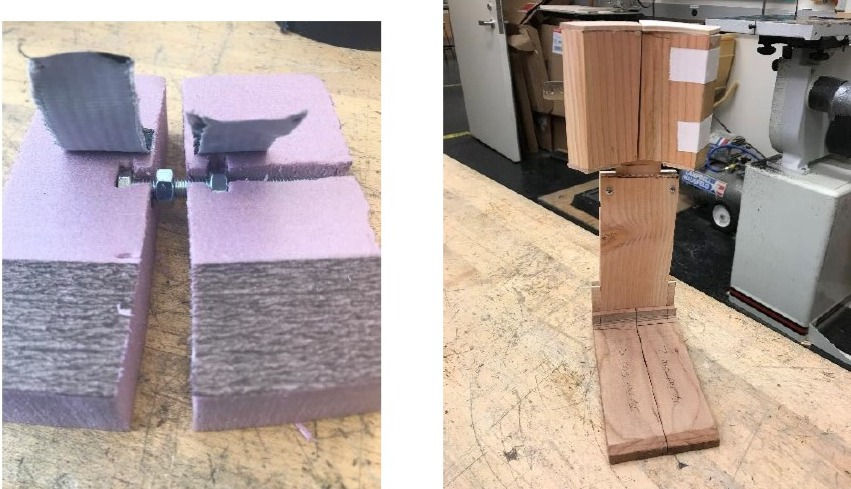
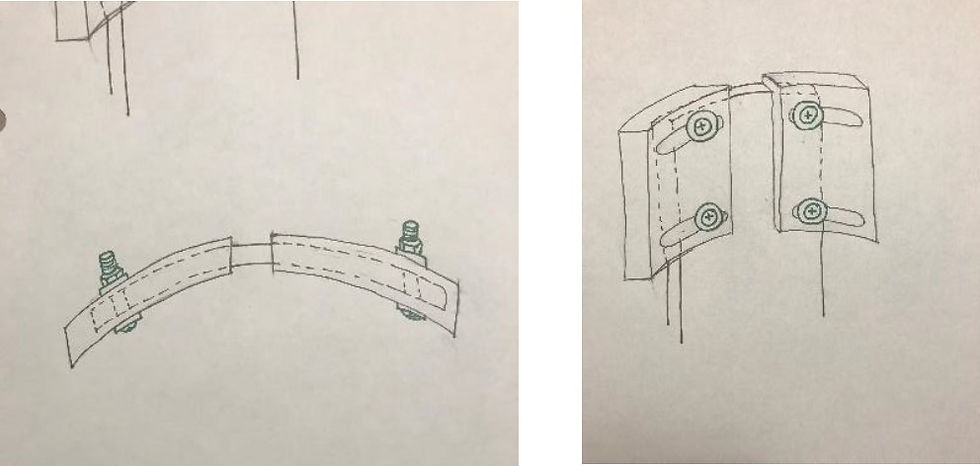
During the prototyping process, we communicated often with Prothesia and asked them feedback on how the concepts met their priorities for the project.
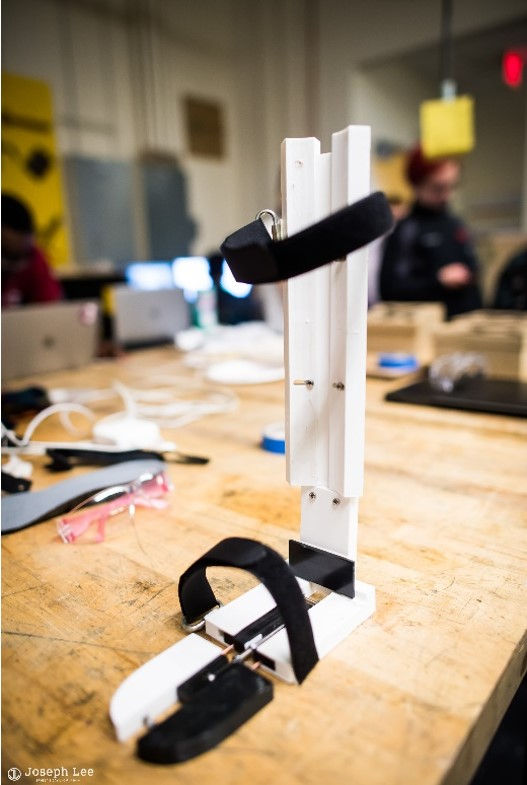
After successfully achieving large 3D-printed pieces with the tolerances we needed for all the moving parts to work together, we presented our findings in front of our D-Lab Design class and share the prototype files with Prothesia.
The system of expansion we had created effectively met our quantitative functional requirements by expanding to the needed lengths and widths.
Qualitatively, the skeleton was meant to be covered by a soft cushion that would help comfort & fit of the child sliding into the orthotic.
A user's manual with more information about assembly & manufacturing can be found here:
In Summary:
This project was my first time working as part of a large team to design for a socially impactful product. To create the ultimate design, we became inspired by the function of an expanding metal retainer and integrated that twisting mechanism into a full-body 3D-printed model. Iterations of foam, wood, and 3D-printed models culminated into a successful presentation and prototype.
While D-Lab Design served as great introduction to the medical device design process, getting there felt haphazard because my team and I did not hold a shared idea of what our scope & vision was from the beginning. I am taking this lesson with me into future design work.
I feel grateful for the opportunity to collaborate with Prothesia, which always served as a source of inspiration for how technology serves to empower families. https://www.prothesia.com/