Spire
- Aug 7, 2021
- 3 min read
Updated: Aug 25, 2023
As part of my mechanical engineering capstone, I designed a system for tracking declining respiratory health with four other engineers. My role in the group was researching signal filtering methods, supporting shipping logistics, crafting data collection procedures to minimize error.
Key Skills: Data Acquisition, Signal Processing, Medical Device Design, IRB Process
Tools: MATLAB, LabVIEW
Timeline: 3.5 months

What I Learned
A high-level understanding of the medical device design process - from ideation to sensor acquisition to IRB rights for validation of data.
Signal filtering for EKG signal, experience with MATLAB and LabVIEW interface.
Design of data collection procedures to minimize error.
Process & Results
Scope
Who
Patients with COPD in ICUs, who need their respiratory health checked continuously to detect declining status.
Why
At the moment, there are no known technologies that continuously monitor the respiratory health of a patient. The patient depends on nurses periodically checking the lungs with stethoscope and spirometer.
How
The Medical Device Design Capstone allows for undergraduate and graduate students to work together to solve a medical challenge through prototyping, ideation, and implementation. My team comprised of 4 graduate students, an undergraduate student (myself), and mentors in both academic and medical fields.
We were given the whole semester to create a prototype and a presentation for the class.
Initial Ideation
Partnering with a medical professional at the Brigham and Women's Hospital in Boston, a need was identified for a non-invasive respiratory device that would continuously track the respiratory health without the need of a spirometer.
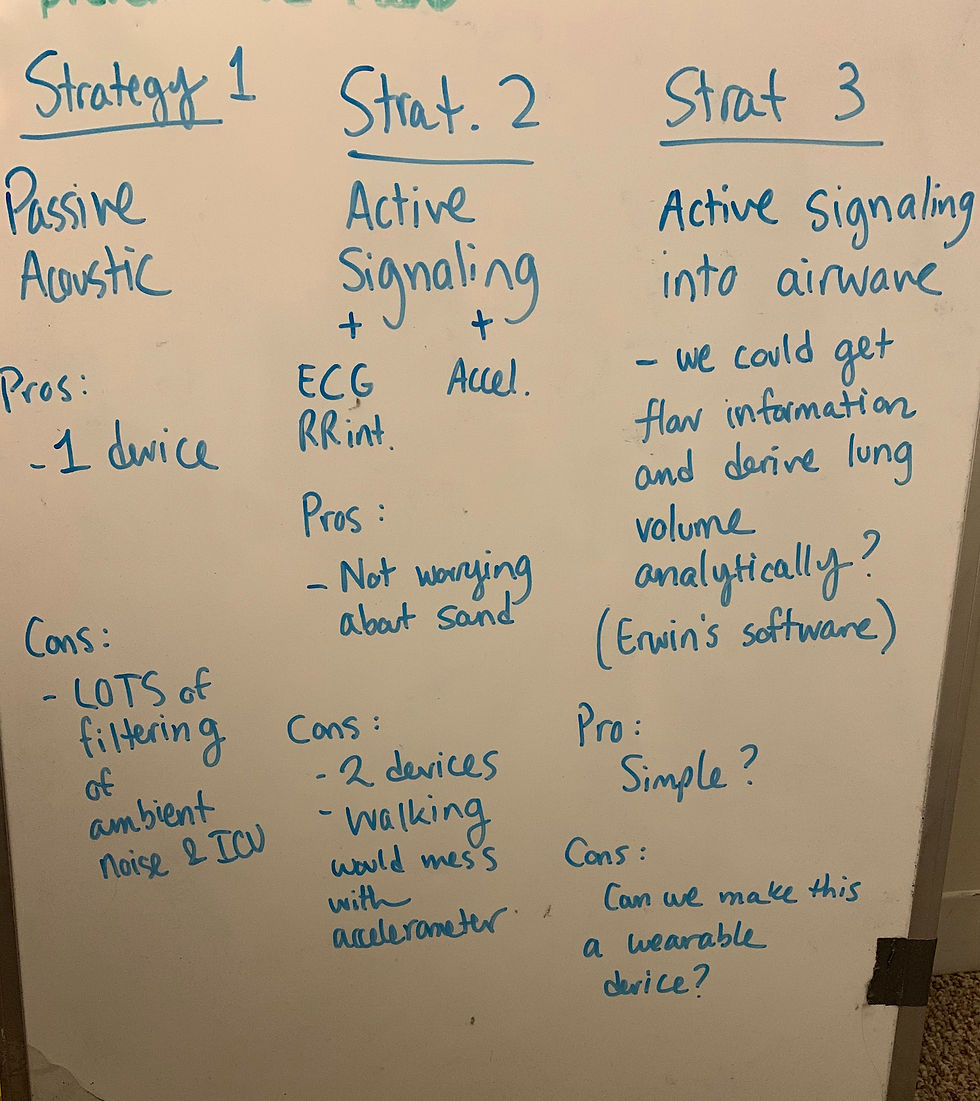
We came up with three possible strategies after ideating through different acoustic (static and active) signals that we could work with. In the end, we decided a passive acoustic signal based on the time and scope of the semester, as well as the tools we could buy with our class budget.
Setting up the experiment
Coordinated purchasing of instruments with class administrator
Kept a budget of our expenses in Microsoft Excel
Took detailed notes during group meetings where design decisions were discussed in detal
Prototyping


Experimental Design
Think about the best way to time various experiments in 1 day, as we had limited time together because of COVID-19 pandemic to collect data.
Because our method depends on acoustic acquisition, chose the appropriate instruments, set-up, and placement on the body to acquire the cleanest signal.
Tools: Microsoft Word, Microsoft Excel, LabVIEW, Spirometer, Stethoscope
I pushed for visual records of what we were accomplishing to be kept in our shared files
Experiment
To validate our set up, we created an experiment with three differing body positions, measuring our biometric signal through all of them.

Academic Writing
My team was encouraged to write a paper with our results and submit to academic conferences
Used Latex to draft, iterate, and consolidate all of our results.
Our paper was published in the IEEE EMBC (Engineering in Medicine & Biology Conference). https://ieeexplore.ieee.org/document/9630839
Clinical Trials Prep
After presenting a successful paper and presentation, the team decided to move forward with implementing the technology in an actual clinical trial, to obtain data better reflective of the potential of the technology.

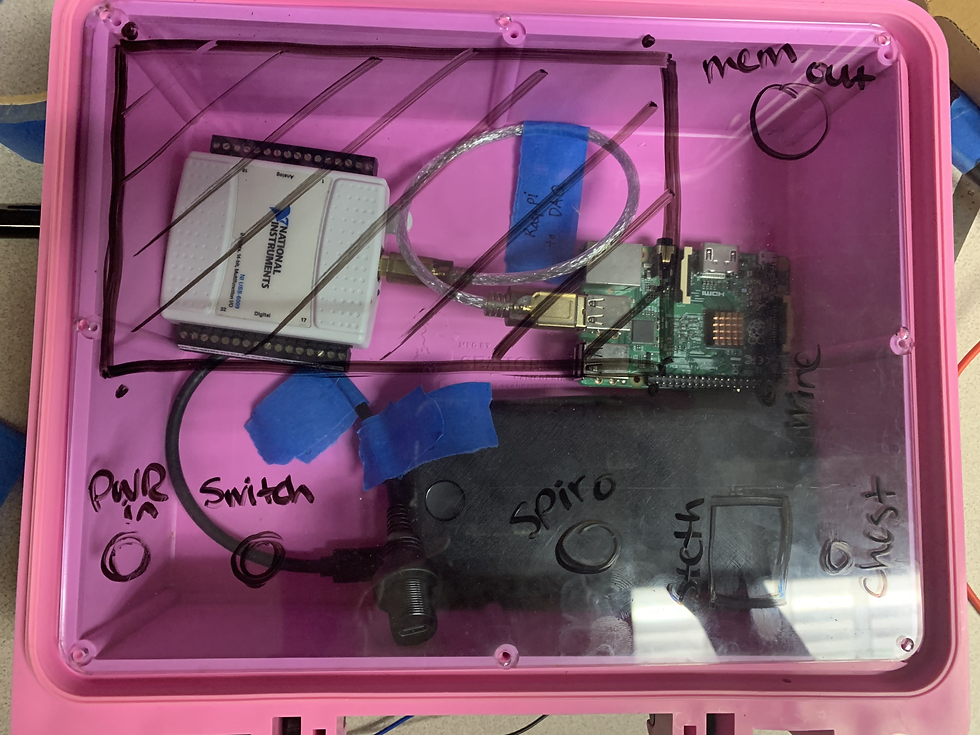
Experimental Design
Deciding what technology would be most accessible to use under ICU context to collect the best data
Spatial reasoning to create a compact & resilient data acquisition box
Communicating with medical mentors to coordinate clinical access & trial logistics
How do we make it more comfortable?
Clinical mentors advised us to explore more comfortable data acquisition methods instead of using a chest belt. One alternative that was suggested was an EKG instead of chest belt to detect the start of inspiration, especially for patients who's COPD would make them sensitive to any pressure around the chest.
Using MATLAB, I achieved a successful filtering technique using EKG signals that captured the movement of the chest that the team may consider integrating in a future, more comfortable design for the user.

Blue: Raw EKG signal. Red: Filtered EKG signal, clearly showing the rise and fall of the chest without noise.

Thank you to Team Lung for this incredible experience!
Comments